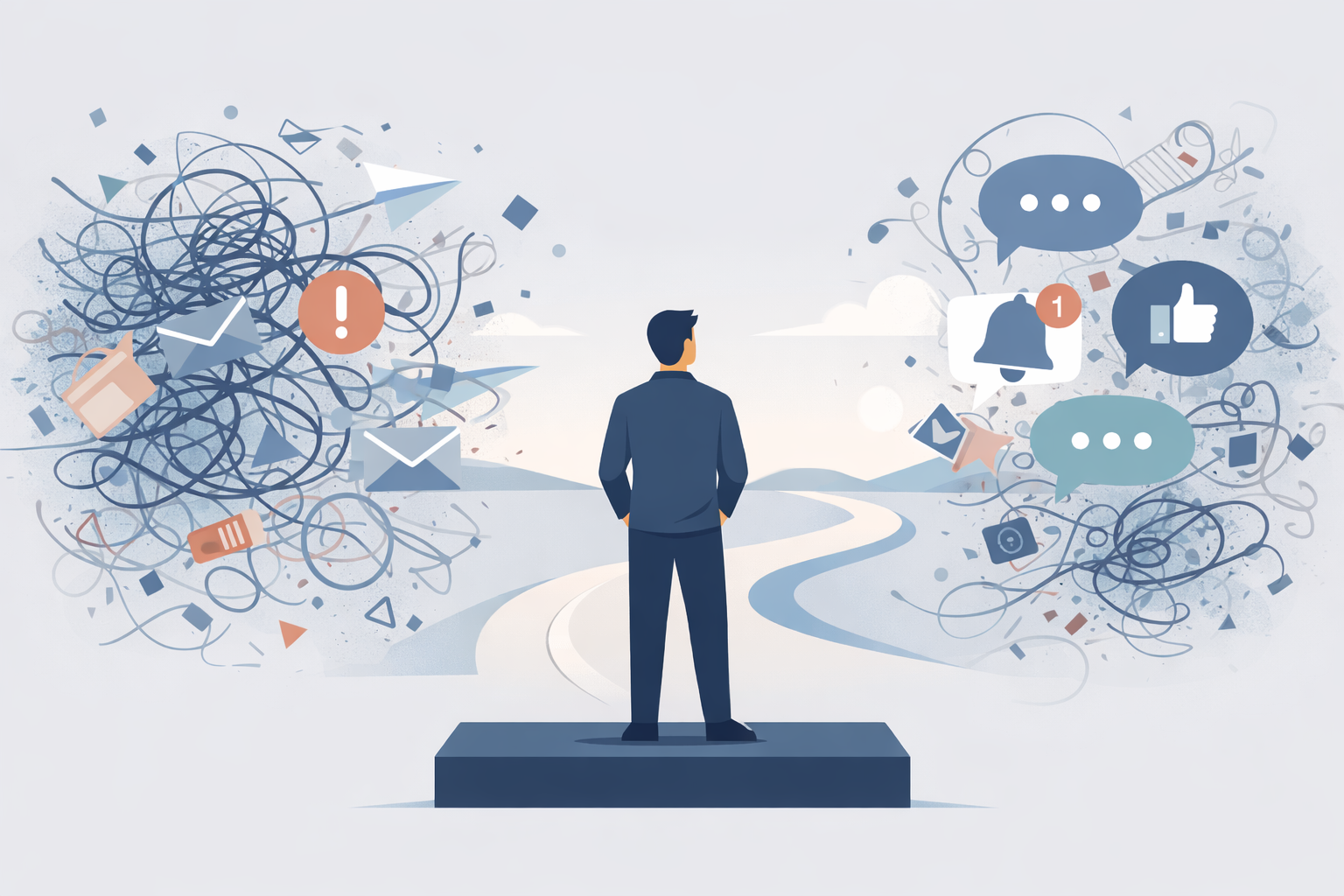
There I was, scrolling through my phone at 7 AM, already absorbing three crises, two outrages, and a dozen opinions about something I hadn’t thought about until that morning. Sound familiar? The world feels constantly on fire and everything demands a response: every headline, every post, every debate, every silence that risks being misread.
As someone who has built companies and spent years advising organizations on programs, strategy and growth, I’ve been thinking about what it means to navigate this noise without losing your footing. And I keep returning to the same idea: the long game. Not as an omission or escape from the chaos, but as a way to move through it with intention and clarity.
Playing the Long Game
The long game is a strategic orientation toward patience, compounding, and sustainable effort. It’s about investing in things that mature over time rather than chasing whatever shines today. It’s about staying the course when turbulence tempts you to abandon your direction. This is relevant for both the public and private sectors.
Consider Estonia. In 1991, the country emerged from Soviet rule with a weak economy and crumbling infrastructure. Rather than chase quick wins, Estonian leaders invested methodically in digital infrastructure and education. No flashy announcements, just decades of patient execution. Today, 99% of government services are online and the country has more startups per capita than almost anywhere in Europe. Thirty years of quiet building created one of the most digitally advanced and startup friendly societies in the world.
Or take LEGO. After nearly going bankrupt in 2004, the company refocused on its core product and stripped away distractions. Then came the 2008 financial crisis, and while competitors scrambled and cut corners, LEGO stayed the course with its back-to-basics strategy. As a result, they quadrupled profits during the recession and emerged as the world’s largest toy company. The long game doesn’t mean ignoring crises; it means having a foundation strong enough to build through them.
Two Ways of Moving Through the World
Consider some contrasts.
There’s the entrepreneur who pivots monthly, chasing whatever trend is dominating the conversation and perpetually repositioning for relevance. Then there’s the one who identified a real problem, developed a clear thesis, and has been compounding quietly ever since.
There’s the leader who optimizes for visibility: the keynote speeches, the podcast appearances, the carefully timed LinkedIn posts. And there’s the one who rarely surfaces publicly but has built a team that would follow them anywhere, because trust was earned through consistency and substance, not immediate performance.
There’s the organization that moves from one strategic priority to the next, always reacting to the latest crisis. Then there’s the one that maintains a clear sense of purpose through turbulent times, making adjustments without abandoning its core direction.
Neither path is inherently right or wrong, but one tends to outlast the other.
Quiet Builders vs. Loud Performers
We live in an era that rewards performance. There’s pressure to be seen having the right opinion on every issue, making the right statement at the right moment, positioning yourself on the correct side of every debate before the window closes. The hot take has become a kind of currency, a way to signal belonging, demonstrate virtue.
The incentives are real and the costs of silence can feel high. But here’s what I’ve noticed: the people who’ve shaped my own trajectory, whether mentors, collaborators, or clients I’ve learned from over the years, were rarely the loudest voices in any room. Their values weren’t announced in public statements, they were evident in their actions. You understood what they believed by watching what they built, who they supported, and how they treated people when no one important was watching.
Often, the loudest voices build the least, while the most enduring contributions come from people who never sought the spotlight. Quiet builders aren’t passive, they’re investing in things that take time to mature: trust, skill, reputation, relationships, and real impact. These things cannot be rushed or performed, they can only be built.
Why This Matters More Now
The long game matters more when the world feels chaotic and direction seems unstable. When everyone around you is reactive, the person who stays focused has a genuine competitive advantage. When others are distracted, exhausted, and overwhelmed by the news cycle and social media frenzy, the long-game player steadily advances. When trust is scarce, those who’ve built it over time become invaluable.
Chaos is disorienting by design. It wants your attention, your energy, your constant reaction. The long game is a way of opting out of that trap. Not by ignoring the world, but by refusing to let the world dictate your priorities.
Active, Not Passive
Playing the long game is not about retreating from the world. It’s not about staying silent when silence is complicity, and it’s not about pretending complexity doesn’t exist. The long game requires action, but action chosen deliberately, not reactively. It means knowing when to speak and when silence serves better, when to move and when to wait.
This reminds me of lessons from martial arts. In Brazilian Jiu-Jitsu, the most dominant grappler on the mat is constantly making micro-adjustments, reading their opponent, testing pressure, anticipating moves. But there’s no wasted motion. Every action serves a purpose and the goal is to make every action count. The same principle applies to business, leadership, and life – especially in times of turmoil.
Questions for the Year Ahead
I’m not going to offer resolutions, as the world has enough prescriptions. What I’ll offer instead are a few questions I’m sitting with as the year turns:
What am I stressing over that won’t matter in five years?
Where am I mistaking motion for progress?
What relationships or skills deserve patient investment this year?
What would I build if I knew no one was watching?
There’s no right answer to any of these. The point is to let the questions do their work.
A new year is a strange thing: it’s arbitrary, of course, just another day on the calendar; but it’s also an invitation to pause, take stock, and choose what comes next. I’m choosing to see 2026 as open space. Not space to be filled with noise, but space to be shaped with intention and room to build things that matter. Time to let the important things compound.
The long game isn’t glamorous and it doesn’t trend. But it’s how lasting things get built.
Image: AI generated for this post


 Entrepreneurship Compass
Leave a comment